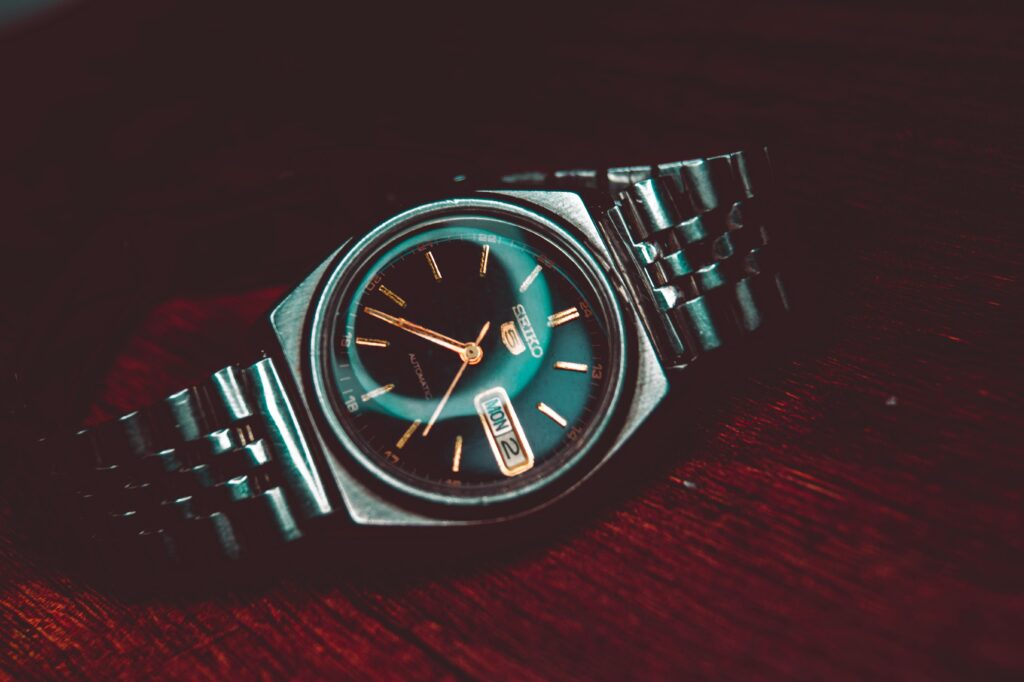
This seiko kinetic buying guide exists because Kinetic is one of the most misread watches on the Japanese used market. It has a rotor that spins like an automatic, so people assume it is mechanical; it needs no routine battery, so people assume it is solar. It is neither. And because so many used Kinetics are listed as “dead,” bargain hunters either overpay for a “working” one or dump a perfectly revivable watch for parts. Getting the technology right is what separates a smart buy from a paperweight.
Below we cover exactly what Kinetic is, the capacitor-versus-cell detail that decides a used purchase, how to revive a “dead” example, which calibers to trust, and how to shop the technology on the Japanese market. If you have just read our Citizen Eco-Drive buying guide, this is the human-powered cousin to that light-powered story.

What Kinetic Actually Is (Not Automatic, Not Solar)
Kinetic is a quartz movement powered by your motion. A weighted rotor swings as you move, spins a tiny generator, and the electricity it makes is stored and used to run a normal quartz movement. So it keeps quartz accuracy – far tighter than a mechanical watch – while charging itself the way an automatic does. The spinning weight fools people, but there is no mainspring here.
Seiko showed the first prototype at Basel in 1986 and launched the first commercial version in 1988 under the name AGS, or Automatic Generating System. The “Kinetic” name arrived in the 1990s as the movements matured. Over the following two decades Seiko built a whole family of Kinetic calibers, from plain three-handers to perpetual calendars, a lineage laid out in Seiko’s own Kinetic reference.
The takeaway for a buyer is simple: treat a Kinetic as a self-charging quartz watch. It will not drift like a mechanical, it does not need light like a solar watch, and its one consumable is the cell that stores the charge – which is exactly where used examples get interesting.
Capacitor or Cell? The Detail That Decides This Seiko Kinetic Buying Guide
Early Kinetics, most famously the caliber 5M42, stored their charge in a capacitor with a short reserve of only a week or two. Those early capacitors turned out to be the technology’s weak point: they were prone to leaking and failing prematurely, and a leaked capacitor is the classic reason an old Kinetic sits dead in a drawer.
Seiko abandoned capacitors and moved to a rechargeable lithium-ion cell with the later movements, the 5M6x family (such as the 5M62) onward, pushing the reserve to around six months on a full charge. When a watchmaker services an old capacitor Kinetic today, they typically fit one of these modern lithium-ion cells in its place, so the fragile part is usually already gone on a serviced example.
There is a catch that will sound familiar from Eco-Drive: lithium-ion cells hate being run flat and left flat. A Kinetic stored for years fully discharged can lose capacity for good. That is why a used Kinetic’s history matters as much as its looks, and why a serviced or regularly-worn example is worth a premium over one that has been dead in a box.
“Dead” Kinetics and the Cheap Revival
Here is the arbitrage at the heart of any seiko kinetic buying guide. A huge share of Kinetics listed as “not working” are simply flat. Give one a good shake, or wear it actively for a day, and a healthy example will often start ticking again. Many models also have a reserve check: press the button and the second hand jumps to a marker – 5, 10, 20 or 30 seconds – to show roughly how much charge is stored.
If a shake brings the seconds hand to life, the movement itself is usually fine and the watch just needs charging or, at most, a fresh cell. A genuine Seiko lithium-ion Kinetic cell is an inexpensive part, so a “dead” watch is frequently a quick, cheap revival rather than a write-off. Sellers who do not know this list them as broken, and that is the listing worth targeting.
The true failure cases are different. An early capacitor model that has leaked, or a cell that has been deeply discharged for years, may never hold a proper charge again – the tell is a watch that charges up but then dies within a day or two of coming off the wrist. Price those as service candidates, not runners.
Kinetic Calibers Worth Knowing in This Seiko Kinetic Buying Guide
You do not need to memorize the whole range, but a few caliber families tell you what you are looking at and how easy it will be to live with.
| Caliber family | What it is | Used-buying note |
|---|---|---|
| 5M42 | Early capacitor three-hander | The leak-prone one; budget for a cell swap |
| 5M6x (5M62 etc.) | Lithium-ion three-hand/day-date workhorse | The safe, plentiful default |
| 7L22 | Kinetic chronograph | Sporty; confirm charge and pushers |
| 5J (5J22 etc.) | Auto Relay (4-year at-rest) | Clever but service-sensitive when tired |
| 5D (5D22 / 5D44) | Direct Drive (hand-wind + gauge) | Manual charging and a live charge readout |
| 7D4x / 7D5x | Kinetic Perpetual calendar | Feature-rich; parts and service cost more |
For a first Kinetic, a lithium-ion 5M6x is the path of least resistance. The more exotic calibers are wonderful, but they raise the stakes if a used one needs work.
Auto Relay, Direct Drive and Perpetual: the Clever Bits
Seiko layered some genuinely inventive features onto Kinetic. Auto Relay, launched in 1998, lets the watch hibernate after about 72 hours of stillness: the hands stop to save power while the movement keeps tracking time internally for up to four years, then snaps back to the correct time the moment you pick it up and move.
Kinetic Direct Drive added the ability to hand-wind the watch and read the exact charge level on a gauge, so you are never guessing. The Kinetic Perpetual, first shown in 2005, combines that long at-rest reserve with a perpetual calendar that stays correct all the way to the year 2100.
These are the models to admire and to approach with a little caution used. When an Auto Relay or Perpetual is healthy it is a marvel, but owners report that a tired one can be stubborn to bring fully back to life, and service on the complex calibers costs more than on a plain 5M6x. Buy the fancy ones from sellers who can show them running.
How to Check a Used Kinetic Before You Buy
A used Kinetic rewards a few specific questions on top of the usual condition checks, and this seiko kinetic buying guide leans on them heavily. Japanese listings tend to be precise, and you can decode their wording with our guide to how Japanese sellers grade watch condition.
- Does it run when shaken? A seconds hand that responds to motion means the movement is alive; a totally unresponsive one needs a closer look.
- What is the caliber? A 5M6x or later is a lithium-ion cell; a 5M42 is an early capacitor – fine, but factor the risk.
- When was the cell last replaced? A recent Seiko cell service resets the one part that ages.
- Does it stop when still? Stopping after a few hours off the wrist points to a worn cell rather than a broken watch.
A watch that has already had a genuine Seiko cell fitted is a plus, not a warning sign. It means the previous owner dealt with the consumable so you do not have to.
What Should You Pay for a Used Kinetic?
One aim of this seiko kinetic buying guide is to stop you overpaying, so treat any figures as moving targets and confirm the current market before you bid. Plain 5M6x three-handers are among the most affordable automatic-quartz watches you can buy, often trading for modest two-figure-to-low-three-figure sums. Auto Relay models tend to sit a step up – roughly the $400–$550 range on the wider market – while chronographs and perpetuals climb higher again. You can sanity-check a reference against current Seiko Kinetic listings on Chrono24 before committing.
Whatever the model, price the cell’s condition in. A cheap Kinetic that needs a service is not as cheap as it looks, and a recently serviced one carries a quiet, fair premium. The maths is the same one we ran for light-powered watches: the movement is durable and the storage cell is the variable.
Kinetic vs Automatic, Solar and Spring Drive
It helps to place Kinetic against its neighbours. Against a mechanical automatic, Kinetic wins on accuracy and loses on the romance of a pure spring – and it adds a cell as a wear item. Against a solar watch such as Casio’s Tough Solar or a Citizen Eco-Drive, the difference is the charging source: your motion instead of light, which suits people who work in dim offices but sit still less happily.
If you want quartz-grade accuracy with no battery worries and a higher ceiling, that is really the argument for Spring Drive, which we touch on in our comparison of Grand Seiko versus standard Seiko. Kinetic occupies a sweet spot below that: clever, affordable, and widely available used, as long as you respect the cell.
Why Buy a Used Kinetic from Japan
Japan is the best hunting ground for Kinetic. The line was hugely popular there, so the domestic used market is deep in every caliber, including designs and limited runs that barely reached other countries. Seiko has quietly de-emphasized Kinetic in recent years in favour of solar and Spring Drive, which only means more good examples flow onto the used market at friendly prices.
You can compare the durable movement and simple servicing needs with our notes on servicing a used Seiko, and check ownership terms in our guide to Japanese warranty for international buyers. When you are ready to buy, our walkthrough for buying on Yahoo Auctions Japan covers the mechanics, and vintage Kinetic oddities also turn up among the best watches to buy on Mercari Japan.
Seiko Kinetic Buying Guide: The Verdict
To close this seiko kinetic buying guide, the winning move is to buy on knowledge the seller lacks. Understand that Kinetic is self-charging quartz, that early 5M42 capacitors are the fragile ones while 5M6x lithium-ion cells are the safe default, and that most “dead” listings are just flat or need a cheap cell. Favour serviced or regularly-worn examples, be cautious with tired Auto Relay and Perpetual pieces, and lean into Japan’s deep supply. Do that, and a used Kinetic is one of the most satisfying low-cost, low-maintenance ways into Japanese watchmaking.
Frequently Asked Questions
Is a Seiko Kinetic automatic or quartz?
Quartz. The rotor charges the watch the way an automatic winds a mainspring, but timekeeping is handled by a quartz movement, so you get quartz accuracy with self-charging convenience. That distinction is the foundation of this seiko kinetic buying guide.
Is a used Kinetic listed as “dead” a bad buy?
Usually not. Most are simply discharged and revive with a shake or a day of wear, and a worn cell is a cheap replacement. Only a leaked early capacitor or a long-deeply-discharged cell is a real problem.
Which Kinetic caliber is the safest to buy used?
A lithium-ion 5M6x such as the 5M62. It is plentiful, reliable, and uses the modern rechargeable cell rather than the leak-prone early capacitor.