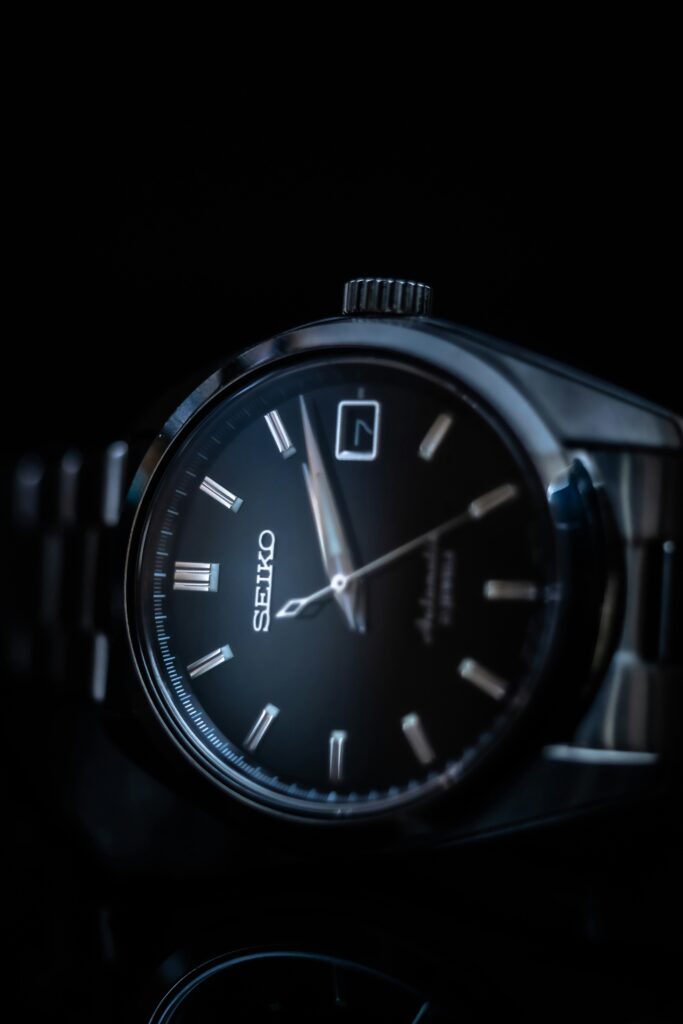
If you have shopped for a used Seiko from Japan, the Seiko J1 vs K1 question has almost certainly stopped you mid-scroll: the exact same watch shows up as SKX007J1 in one listing and SKX007K1 in another, and the J1 costs more. Sellers rarely explain the difference, forums argue about it endlessly, and half the “answers” online quietly mix up three completely different codes. This guide untangles all of it — what the suffix actually means, why Japan-market watches use entirely different reference numbers, whether the pricier version is worth it, and how the whole thing changes when you buy from Japan rather than a Western retailer.
Seiko J1 vs K1: The Short Answer
The letter is a market and origin code attached to the model number, not a quality grade. On an international Seiko reference like SKX007J1 or SRPD79K1, the letter tells you where the watch was assembled and which market it was built for. A J watch is finished in Japan and carries a “Made in Japan” line on the dial. A K watch is assembled at one of Seiko’s other facilities — commonly Malaysia or Singapore — and its dial usually reads “Mov’t Japan” or carries no origin line at all.
That single dial difference is the entire practical basis of the Seiko J1 vs K1 price gap. The movements, cases, and specifications are otherwise the same watch. Collectors pay a premium — often around fifty dollars, sometimes much more on discontinued models — largely for the words printed near the six o’clock marker.
What the Numbers After the Letter Mean
The trailing digit trips people up almost as often as the letter. In SKX007J1, the “1” does not mean “version one” or “first quality.” It is a band or variant indicator — Seiko uses it to flag that the same watch exists with other strap and bracelet options. So SKX007J1 and SKX007J2 are the identical Japan-made watch with different straps, not different quality tiers.
This matters when you compare listings: a J1 and a J2 are equivalent for authenticity and origin purposes, and the number should never push the price up on its own. Treat the letter as the meaningful part and the digit as a footnote about what came in the box.
The Code Everyone Confuses It With: The Serial Number
Here is where most online explanations go wrong, and where you can avoid an expensive mistake. The letter in the model number (the J or K in SKX007J1) is not the same as the letter in the serial number stamped on the caseback. They are two unrelated systems.
In a Seiko serial number, the first digit is the production year within a decade and the second character — often a letter — encodes the production month. A serial number containing a J or K there simply tells you when the watch was made, not where. If someone tells you “your serial has a K, so it is a Malaysian watch,” they are conflating the two codes. When you assess a used Seiko, read the model-number suffix for origin and read the serial number for the production date — never mix them.
JDM References: The Third System That Changes Everything
Now the part that actually matters most when you buy from Japan. Watches sold on the Japanese domestic market (JDM) frequently do not use the SKX/SPB/SRP international names with a J or K suffix at all. They get their own reference numbers — and those references carry no suffix, because in Japan there is nothing to distinguish.
The clearest way to see it is through pairs. The green Alpinist sold internationally as SPB121J1 is sold in Japan as SBDC091 — same watch, two naming systems. The Turtle diver sold abroad as SRPC91J1 is the JDM SBDY021. And a watch like the SARB017 only ever existed as a JDM reference; there is no “SARB017K1,” because it was never built for the export catalogue. We walk through the Alpinist example in detail in our guide to the best used Seiko Alpinist references from Japan, and the same logic applies across the lineup.
So when you shop Japanese marketplaces, you will mostly encounter these JDM reference numbers rather than J1/K1 suffixes. That is a feature, not a bug: JDM references are the Japan-made, Japan-market pieces, which is exactly what most collectors chasing the Seiko J1 vs K1 premium are trying to buy in the first place.
Does “Made in Japan” Actually Mean Made in Japan?
Fairly, yes — with a nuance worth understanding. Under the rules Seiko follows as a member of the Japan Clock & Watch Association, a watch’s country of origin is defined by where the movement is assembled. To avoid misleading buyers, member companies apply the “Made in Japan” mark only when both the movement assembly and the final watch assembly happened in Japan. In other words, a J-marked Seiko has met a defined standard, not a marketing whim.
The honest caveat is that a modern “Made in Japan” Seiko may still contain parts produced elsewhere, and the real-world quality gap between a J and a K of the same reference is usually minimal — Seiko runs strict quality control across all its plants. The Seiko J1 vs K1 decision is therefore mostly about provenance, dial text, and resale value rather than a mechanical difference you would ever feel on the wrist.
Other Small Differences Between J and K Models
Beyond the dial line, a few market-specific details occasionally vary between J and K versions of the same model, and they are worth checking against photos before you bid:
- Day wheels. Depending on the destination market, the day-of-week disk may show English plus another language. Some J-market pieces pair English with Kanji or Arabic; many K-market European pieces pair English with French or Spanish.
- Bracelet length. Bracelets fitted for certain markets are sometimes sized for smaller wrists, so a J and a K can arrive with slightly different numbers of links.
- Packaging and warranty paperwork. The market a watch was built for affects the booklet, warranty card, and box — relevant if you care about a complete set.
None of these change how the watch runs, but they do affect whether a specific example is right for you, and they help confirm a listing is what it claims to be.
Seiko J1 vs K1: Which Should You Actually Buy?
For most buyers the answer is pragmatic rather than dogmatic. If two examples are genuinely equal in condition and the J commands only a small premium, the J is the easier watch to resell later and scratches the “Made in Japan” itch — a reasonable choice. If the J premium balloons well beyond the usual gap, you are paying for a dial inscription and collector sentiment, and a clean K is the smarter value.
What you should not do is treat a K as damaged goods. A K-model SKX or Seiko 5 is the same well-built watch, and on the used market condition, service history, and completeness matter far more than the origin letter. We put real numbers on how much the Japan-made premium moves prices in our breakdown of used Seiko prices in Japan versus eBay, and the pattern is consistent: pay for condition first, provenance second.
How the J1/K1 Question Plays Out When You Buy From Japan
Buying from the source flips the usual math. In the West you often choose between a J1 and a K1 of the same international reference. On Yahoo Auctions Japan and Mercari Japan, you are mostly looking at JDM references and Japan-made pieces to begin with, so the “should I hold out for the J” dilemma often disappears — you are already in J territory. Our step-by-step guide to buying watches on Yahoo Auctions Japan covers how to search these listings, and the Mercari Japan watch buying guide explains the fixed-price side.
Because neither platform ships abroad or takes most foreign cards, you will buy through a proxy service such as Buyee, ZenMarket, or From Japan — we compare them in our roundup of the best proxy services for buying watches from Japan. Search using both the JDM reference and the international name when you know both: querying SBDC091 and SPB121 surfaces different listings, and the JDM reference usually pulls up more Japan-based sellers.
Using the Dial Text to Verify Authenticity
The Seiko J1 vs K1 dial line is not just a value marker — it is also a useful authenticity checkpoint. Because the “Made in Japan” and “Mov’t Japan” text sits in a specific spot near six o’clock, a listing photo that shows it lets you confirm the dial matches the reference being sold. A mismatch — a K-market watch advertised as a J, or a dial line that does not correspond to the claimed model — is a signal to slow down.
This dovetails with the wider skill of reading a Japanese listing honestly. Learn the condition vocabulary in our guide to Japanese watch condition grades, and if you are shopping vintage, study the redial tells in our breakdown of how to spot a redialed vintage Seiko, since a refinished dial can add, remove, or fake exactly the origin text that drives the J premium.
Quick Reference: Decoding a Seiko Listing
| What you see | Where it is | What it tells you |
|---|---|---|
| J1 / K1 suffix | End of model number (SKX007J1) | Origin/market: J = Japan-assembled, K = elsewhere |
| Trailing digit (the “1”) | After J/K | Band/strap variant — not quality |
| SBDC / SARB / SBDY reference | The whole model number | JDM reference — Japan-market, no suffix needed |
| Letter in serial number | Caseback engraving | Production month — unrelated to J/K origin |
| “Made in Japan” vs “Mov’t Japan” | Dial, near 6 o’clock | Confirms origin and helps verify the dial |
Cross-check unfamiliar references against a database like Chrono24’s Seiko catalogue before you commit, and if you want to see how the J premium moves on a specific model, historical sold data on WatchCharts is the fastest sanity check.
The Bottom Line on Seiko J1 vs K1
Strip away the forum mythology and the Seiko J1 vs K1 question comes down to three separate codes you now know how to read: the model-number suffix tells you origin, the trailing digit tells you the strap variant, and the serial-number letter tells you the production month. JDM references sidestep the suffix entirely, which is why buying from Japan usually puts you in Japan-made territory without the guesswork.
Pay for condition and completeness first, treat the “Made in Japan” dial line as a modest bonus rather than a mechanical upgrade, and you will never overpay for a letter again. That is the whole Seiko J1 vs K1 lesson in a sentence. When you are ready to buy, the same discipline that decodes the reference number will get the watch to your door — see our guide to shipping watches from Japan for the final step.