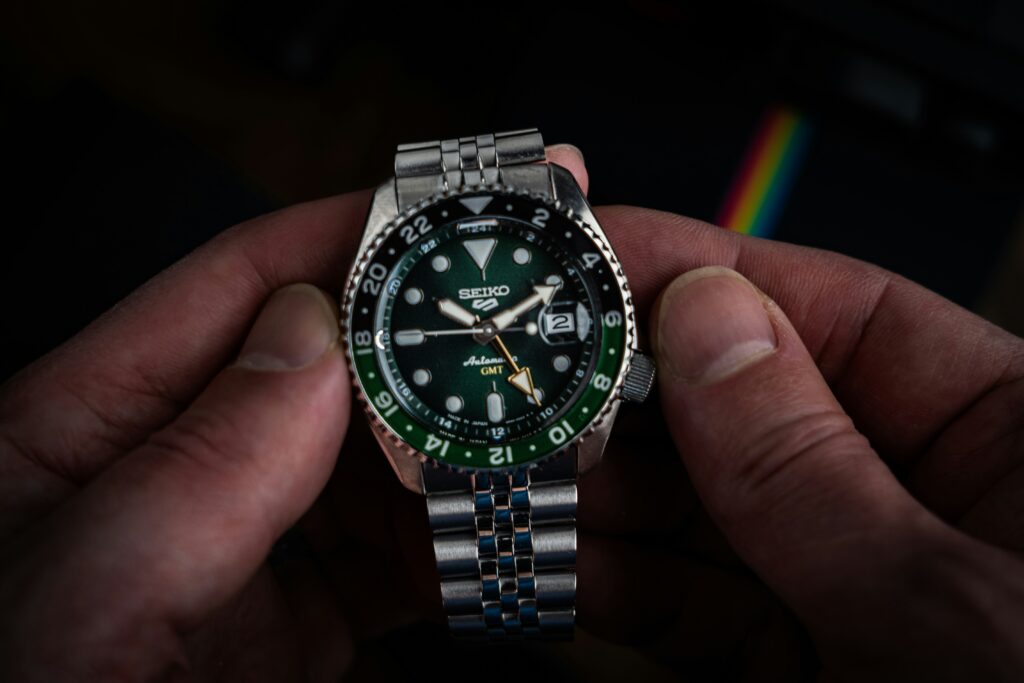
The best GMT watches from Japan give you a second time zone, serious build quality, and prices that make their Swiss equivalents look absurd. Over the past few years Japanese brands have quietly taken over the affordable GMT category: Seiko’s 5 Sports GMT put a mechanical dual-time watch under most people’s budget ceiling, Citizen followed with its own mechanical GMT, and Grand Seiko has been building some of the finest travel watches in the world all along.
Better still for readers of this site, Japan’s domestic market adds a layer most guides ignore: JDM-exclusive references you can only buy from Japan, and a deep used market where discontinued colorways surface daily. This guide walks through the best GMT watches from Japan across every budget, explains the caller-versus-traveler distinction most listings get wrong, and shows you exactly how to buy — new or used — from Japanese platforms.
Why Buy a GMT Watch from Japan?
Three reasons. First, selection: several desirable references are Japan-exclusive, and Japanese retailers stock dial and bezel variants that never officially ship overseas. Second, price: domestic Japanese pricing and a liquid secondhand market frequently undercut Western retail, a pattern we documented in our Japan vs eBay price comparison. Third, condition transparency: Japanese sellers grade honestly and describe flaws in detail, using the vocabulary from our guide to Japanese watch condition grades.
Whether you buy new from a Japanese online dealer or used through an auction proxy, the process is well-trodden — we cover both paths at the end of this guide.
Best GMT Watches from Japan: Quick Picks
Here is the short list before we go model by model. Every entry below is either currently sold in Japan or abundant on the Japanese secondhand market — availability is part of what makes these the best GMT watches from Japan rather than just on paper.
| Model | Movement | GMT Type | Best For |
|---|---|---|---|
| Seiko 5 Sports GMT (SSK001/003/005) | 4R34 automatic | Caller | First mechanical GMT |
| Seiko 5 Field GMT (SSK023/025) | 4R34 automatic | Caller | Explorer-style looks, smaller case |
| Seiko 5 Field GMT JDM (SBSC series) | 4R34 automatic | Caller | Japan-exclusive dials |
| Seiko Presage GMT | Automatic | Caller | Dressier styling |
| Citizen Series 8 GMT | Mechanical | True/traveler | Modern angular design |
| Citizen Nighthawk | Eco-Drive quartz | Quartz dual-time | Rugged budget pilot GMT |
| Grand Seiko GMT (SBGM/SBGJ/SBGN/SBGE) | Mechanical / 9F quartz / Spring Drive | Traveler | Endgame quality |
Caller vs Traveler GMT: The Distinction That Matters
Before you buy, know which type you are getting, because listings rarely say. A caller GMT lets you set the 24-hour hand independently — perfect for tracking a second time zone from home (say, calling colleagues abroad). A traveler GMT lets you jump the local 12-hour hand independently instead, which is what you want when you actually cross time zones and need to reset local time without stopping the watch.
The affordable Japanese options — Seiko’s 4R34-powered models and the Presage GMTs — are caller style. Grand Seiko’s mechanical GMTs and Citizen’s Series 8 GMT are traveler style with an independently adjustable hour hand. Neither is “better”; they suit different lives. Frequent flyers should weight the traveler models; everyone else will be perfectly happy with a caller.
Seiko 5 Sports GMT: The Watch That Changed the Category
When Seiko dropped the 5 Sports GMT in 2022, it instantly became the default answer to “cheapest respectable mechanical GMT.” The core trio — black-dial SSK001, blue SSK003, and orange SSK005 — runs the 4R34 automatic in a 42.5mm case that borrows heavily from the beloved SKX, which is why the community nicknamed it the “SKX GMT.”
Be realistic about what the price buys: Hardlex rather than sapphire, an aluminum bezel insert, and a bi-directional friction bezel rather than a clicking one. None of that matters much in daily use, and the value equation is why the SSK sells in enormous volume. The 4R34 sits in the same movement family we covered in our roundup of the best used Seiko 5 watches from Japan — robust, serviceable, and everywhere in Japan’s secondhand market already.
The newer Field GMT versions (SSK023, SSK025) shrink the case to about 39.4mm and swap the dive-adjacent styling for an Explorer-style field look. If the 42.5mm SSK wears too big for you, this is the one to hunt. Seiko also keeps adding limited editions and fresh colorways to the line, so it is worth checking the current lineup on Seiko’s official site before you commit — discontinued SSK colorways tend to appear on the Japanese used market within months, often barely worn.
The JDM Angle: Japan-Exclusive SBSC References
Here is the part most Western guides skip entirely. Seiko sells Japan-domestic versions of the Field GMT under SBSC reference codes — including dial colors, like the white-dial SBSC009, that have no international equivalent. They are “Made in Japan” JDM stock, sold through Japanese retailers, and the only practical ways to get one are a Japanese online dealer that ships abroad or a proxy purchase.
This is exactly the sweet spot this site exists for: a current-production watch that is genuinely easier to buy from Japan than anywhere else. Our guide to Japanese watch stores that sell online covers the dealer route, and the proxy route works the same as for any auction win.
Seiko Presage GMT: The Dressier Option
If the 5 Sports GMT is the tool-watch answer, Presage is the dress-casual one. The Presage range includes automatic GMT models with the line’s signature refined dials — a natural pick if your second-time-zone watch also needs to survive a dinner jacket. We covered where the GMT models sit within the collection in our guide to the best used Seiko Presage from Japan. Presage GMTs rarely headline roundups of the best GMT watches from Japan, and that relative obscurity works in your favor: on the secondhand market they trade at a friendly discount to retail, as most Presage references do, while offering finishing a clear step above the 5 Sports line.
Citizen: Series 8 GMT and the Nighthawk
Citizen’s Series 8 GMT is the brand’s modern mechanical answer — an angular, integrated-bracelet sports watch whose GMT implementation is the traveler type, with an independently adjustable hour hand. It competes a price tier above the Seiko 5 GMT and undercuts comparable Swiss travelers significantly. The finishing — brushed integrated bracelet, sharply faceted case — reads far more expensive than it is, and because the model line is still young, Japanese supply is strong both new and lightly used, with early buyers already trading up or out.
At the budget end, the long-running Nighthawk gives you Eco-Drive quartz dual-time functionality in a rugged pilot-watch package for very little money, and Japanese listings are plentiful. For the wider brand picture, our roundup of the best used Citizen watches from Japan covers what else the brand does well.
Grand Seiko GMT: The Endgame
At the top of the pyramid, Grand Seiko builds GMTs in three flavors: mechanical references like the cream-dial SBGM221, Hi-Beat sports GMTs in the SBGJ line, ultra-precise 9F quartz GMTs in the SBGN line, and Spring Drive GMTs in the SBGE line. The mechanical and Spring Drive models use traveler-style independent hour hands — genuine travel watches, finished to a standard that embarrasses watches costing multiples more.
Grand Seiko is also where buying used from Japan saves the most absolute money, since depreciation on used GS is substantial while the watches themselves age gracefully. Our comparison of Grand Seiko versus Seiko on the used market explains the value dynamics; check current used pricing on Chrono24 against Japanese auction results before you decide where to buy. If budget is not the constraint, this tier is simply where the best GMT watches from Japan live.
How to Buy from Japan — and What to Check Before You Pay
For new watches — especially JDM exclusives like the SBSC field GMTs — buy from a Japanese online dealer that ships internationally, or use a proxy to purchase from a domestic retailer that does not.
For used watches, the deepest supply of the best GMT watches from Japan sits on Yahoo Auctions Japan and Mercari Japan. Neither supports foreign buyers directly, so most overseas collectors go through a proxy service such as Buyee, ZenMarket, or From Japan — compared in detail in our guide to the best proxy service for buying watches from Japan. The full auction workflow, from search terms to bidding, is in our Yahoo Auctions Japan buying guide.
The best GMT watches from Japan are only bargains if the complication actually works, so add these GMT-specific inspection points on top of the usual used-watch checks:
- GMT hand function: Confirm the independent hand (24-hour hand on callers, local hour hand on travelers) actually adjusts through the crown and aligns correctly with the dial’s 24-hour scale.
- Bezel condition: On models with a 24-hour bezel, check for fading and confirm it still rotates. Friction bezels on the SSK series loosen with heavy wear.
- Quickset behavior: Misaligned date or a GMT hand that no longer hits the markers squarely suggests a hard knock or amateur service.
- Bracelet stock: The jubilee-style bracelets on the SSK trio are often swapped for aftermarket straps; confirm the original bracelet is included if the listing price assumes it.
Prices across all these models move with demand and currency, so treat any number you see in a guide as a snapshot and verify against live listings before bidding.
Frequently Asked Questions
What are the best GMT watches from Japan on a tight budget?
The Citizen Nighthawk (quartz) and a used Seiko 5 Sports GMT are the two strongest entry points. Both are abundant on Japanese platforms and cheap to run.
Is the Seiko 5 GMT a true GMT?
It is a caller-style GMT: the 24-hour hand adjusts independently, but the local hour hand does not jump on its own. “True GMT” usually refers to traveler-style movements like those in Grand Seiko mechanicals and the Citizen Series 8 GMT.
Are JDM Seiko GMTs different from international versions?
Mechanically they are the same platform; the differences are reference codes, certain dial colors, “Made in Japan” casebacks on JDM stock, and warranty coverage — Japanese-market watches typically carry domestic-only warranties, so factor that in.
Do GMT watches cost more to service?
Slightly, yes — the extra hand and setting mechanism add complexity, though far less than a chronograph does. For the 4R34-based Seikos, movement replacement is often cheaper than a full overhaul, which keeps long-term ownership costs low.
Should I buy new or used?
For JDM exclusives, new from a Japanese dealer is often simplest. For everything else, the used market usually wins on price — the discount on used Grand Seiko in particular is hard to ignore.
Final Verdict
The best GMT watches from Japan cover every budget without a weak link in the chain. Start with a Seiko 5 Sports or Field GMT if you want maximum function per dollar, step up to the Citizen Series 8 for a true traveler complication, and graduate to Grand Seiko when finishing and precision start to matter more than price. And if you want something nobody at your local watch meetup can buy at the mall, the Japan-only SBSC field GMTs are sitting in Japanese dealer stock right now.
Pick your model, then follow the playbook: verify condition with the grading vocabulary, run the GMT-specific checks above, and buy through a reputable dealer or proxy. A second time zone on your wrist has never been this accessible — and Japan is the best place on earth to get it.