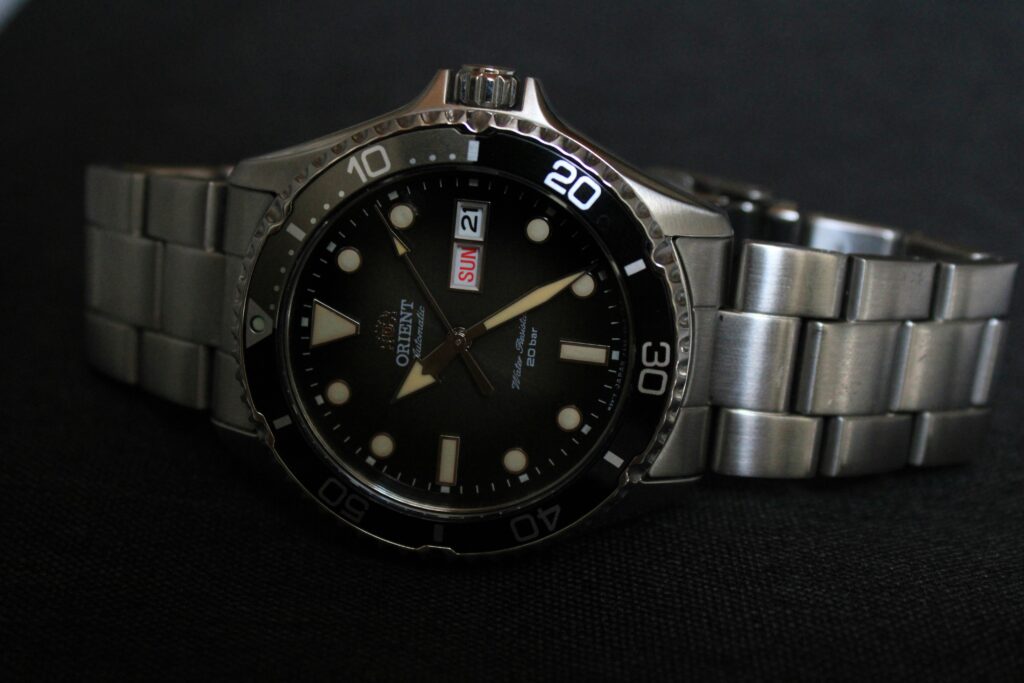
Working out the best Orient watches used Japan has on offer means understanding one thing first: Orient sells two different catalogues, and only one of them reaches Western shops. The brand splits its references between domestic and export models, and the domestic side holds dials, finishes, and entire collections that never leave the country.
Orient has been making mechanical watches with in-house movements since 1950, tracing its roots to a Tokyo shop that opened in 1901. Today it sits under the Seiko Epson umbrella, which is why the value proposition feels familiar — serious watchmaking at prices that look like a mistake. This guide ranks seven models worth buying used from Japan and explains how to read the references so you know what you are actually looking at.
Why the Best Orient Watches Used Japan Sells Are JDM References
Orient uses a prefix system that tells you immediately which market a watch was built for. References starting RA- are export models sold internationally. References starting RN- are Japan domestic market watches.
The two are often mechanically identical, but not always. JDM versions frequently carry different dial colours, come with a Japanese warranty card, and occasionally use a different crystal or bracelet at the same price point. Some collections, particularly at the upper end, barely appear outside Japan at all.
This is the entire argument for buying domestically. A Western buyer chooses from the export slice; a buyer shopping the Japanese market chooses from everything. Older vintage Orient references never used the RA/RN system at all, which is a separate hunting ground and one where Japan is effectively the only source.
1. Orient Bambino — The Default Recommendation
Ask any watch forum for a first mechanical watch and the Bambino appears before you finish typing. It is a domed-crystal dress automatic with applied markers and a restrained dial, and it has been the answer to “cheap mechanical dress watch” for over a decade.
It is also the most common of the best Orient watches used Japan lists at any given moment, which means you can afford to be picky. The line has run through several generations, and they differ more than the shared name suggests. Earlier versions run 40.5mm and wear large for a dress watch; later small-seconds and 38mm variants suit smaller wrists considerably better. If a small case is your priority, it is worth seeing how Orient stacks up against the other best Japanese watches for small wrists. Used examples typically land in the $150–250 range, with JDM dial colours occupying the interesting end.
Check the crystal specification before buying. Most Bambinos use mineral glass rather than sapphire, and a scratched domed crystal is very visible on a dress watch.
2. Orient Kamasu (Mako III) — The Sapphire Diver
The Kamasu is the value champion of the range and, for many buyers, the single best Orient watch used Japan supplies. Named after the Japanese word for barracuda, it succeeded the Mako I and II and fixed their main weakness by fitting sapphire crystal as standard.
Specifications punch far above the price: the in-house F6922 automatic with hacking and hand-winding, 200m water resistance, a 41.8mm case, and a genuinely well-executed bezel. Used prices generally run $175–275 depending on dial and completeness. Black and blue are common; green and burgundy carry a small premium.
If you want to see how it stacks up against the obvious rival, our guide to the best used Seiko divers from Japan covers the SKX and Prospex side of that argument.
3. Orient Mako II and Ray II — The Budget Divers
The predecessors remain excellent buys precisely because the Kamasu replaced them. Same 200m rating, same in-house automatic architecture, mineral crystal instead of sapphire, and a noticeably lower price — often under $150 used.
The Mako and Ray differ mainly in dial and bezel treatment; the Ray is the cleaner of the two. Both are among the best Orient watches used Japan can supply if your budget is genuinely tight and you would rather have a real dive watch than a compromised dress watch.
4. Orient Sun and Moon — The Character Pick
Among the best Orient watches used Japan offers, this is the one with the most personality. The Sun and Moon adds a rotating day-night indicator at twelve o’clock, and it is the model that makes people who do not care about watches ask about your watch. Mechanically it is a straightforward automatic; visually it does something no similarly priced Swiss watch attempts. Just know the display is a day-night indicator, not a true lunar complication — for the real thing, see the Orient Star picks in our guide to the best moonphase watches from Japan.
Used prices typically sit around $200–320. Multiple generations exist with different case sizes and dial layouts, so check the reference rather than assuming. Later versions refined the proportions considerably.
5. Orient Star — The Serious Step Up
Orient Star is the brand’s upmarket line, and it is the collection Western buyers most often do not know exists. Better movements with longer power reserves, higher-grade finishing, applied indices with proper polishing, and sapphire throughout.
This is where Orient stops being an entry-level brand and starts competing with mid-tier Swiss on finishing. The Contemporary and Classic sub-lines cover dress territory; the Sports side covers divers with more substance than the standard range. Used prices vary widely — roughly $250 to $600 depending on reference, with power-reserve and skeleton models at the upper end.
Crucially, Orient Star is heavily weighted toward the domestic market. Many references were never exported, which makes Japan the natural place to shop for them and makes this line the strongest argument in this entire guide.
6. Orient Neo 70’s — JDM Retro
The Neo 70’s line is a Japan-focused revival of the brand’s 1970s design language: panda chronograph dials, integrated bracelets, and solar quartz movements in most references. These barely register outside Japan, which keeps prices low.
Used examples often appear around $120–200 from Japanese sellers. They are quartz rather than mechanical, which some buyers will consider a dealbreaker and others will consider maintenance-free convenience. Either way, this is a collection you will struggle to find anywhere except the Japanese market.
7. Vintage Orient — King Diver, President, and Grand Prix
Some of the best Orient watches used Japan holds are not in the current catalogue at all. Orient’s back catalogue is deep and underexplored. The King Diver from the late 1960s, the President day-date dress line, and the Grand Prix series all trade well below equivalent vintage Seiko because collector attention has never focused here.
Prices range enormously — anywhere from $200 for a common President to $500 and beyond for a clean King Diver. Vintage buying carries real risk: service history is usually unknown, replacement parts are scarce, and redialled examples circulate. Buy from sellers who photograph the movement, and budget for a service.
Understanding Orient’s In-House Movements
Movement choice separates the best Orient watches used Japan sells from the merely cheap ones. Orient manufactures its own calibres, which is unusual at this price and is the main reason the brand keeps its reputation among enthusiasts.
F6922 and F6722 are the current workhorses, found in the Kamasu and modern Bambino references. They hack, hand-wind, and run roughly 40 hours. Accuracy is specified loosely but real-world performance is typically far better than the spec sheet suggests.
Calibre 46 series powers older Mako, Ray, and earlier Bambino models. These do not hack or hand-wind, which surprises buyers coming from Seiko’s newer movements. They are otherwise robust and cheap to service.
Orient Star calibres offer longer reserves — 50 hours and up — and tighter regulation. This is the specification difference that justifies the price gap.
What to Check Before You Buy
Orient’s affordability cuts both ways: owners often treat these as daily beaters, so condition varies more than it does on watches people baby.
Crystal type and condition. Mineral on most standard references, sapphire on Kamasu and Orient Star. A scratched mineral crystal is cheap to replace but factor it into your offer.
Bracelet stretch. Orient’s cheaper bracelets develop play over time. Check for sag in the seller’s photographs and confirm whether spare links are included.
Movement function. On calibre 46 models, remember that no hand-winding is normal, not a fault. On F-series references, hand-winding should feel smooth.
Japanese sellers grade condition with a standardised vocabulary, and learning it is the fastest route to a fair price. Our guide to Japanese watch condition grades decodes the labels.
Where to Find the Best Orient Watches Used Japan Listings
Yahoo Auctions Japan carries the deepest supply, particularly for vintage references and Orient Star models that dealers list properly. Our complete guide to buying watches on Yahoo Auctions Japan walks through the process.
Mercari Japan suits the mainstream Bambino and Mako references that ordinary owners sell at fixed prices. Our Mercari Japan watch buying guide covers searching and negotiating, and our roundup of the best watches to buy on Mercari Japan explains why mainstream models do better there than rarities.
Neither ships internationally, so you will need a proxy. Our comparison of the best proxy services for Japanese watches picks a winner for each case, and our guide to shipping watches from Japan covers carriers, insurance, and duty.
How Much Should You Actually Pay?
Budget for the watch plus roughly 15–25% in proxy fees, shipping, and import duty. Because Orient sits at a low absolute price, that percentage stings more here than it does on an expensive watch — a $150 Mako can end up costing $200 landed, which changes the calculation.
This is the one real argument against buying Orient from Japan: on common export references, your local market may be competitive once fees are counted. The maths swings decisively back in Japan’s favour on JDM-only references, Orient Star, and vintage — which is exactly where the best Orient watches used Japan offers actually live.
Check any reference against real market data on WatchCharts or current dealer asking prices on Chrono24 before committing. Figures in this guide are approximate and move with the market.
Which Orient Is Right for You?
There is no single best Orient watch used Japan can sell you, but there is a clear pick for each kind of buyer. For a first mechanical watch, the Bambino is still the answer. For the most watch per dollar, the Kamasu is untouchable. For something nobody at the office will recognise, Orient Star or a Neo 70’s. For a genuine hunt, the vintage catalogue.
If you are still deciding between brands entirely, our comparison of Orient versus Seiko used weighs the two directly, and our roundup of the best Japanese watches to buy used widens the field to six brands. If a dress watch is what you actually want, the best used Seiko Presage references are the obvious cross-shop.
Frequently Asked Questions
Is Orient owned by Seiko? Effectively yes — Orient operates under Seiko Epson. It retains its own movement manufacturing and design identity, which is why the watches do not feel like rebadged Seikos.
What does the RN prefix mean? It marks a Japan domestic market reference. RA- marks an export model. Same watch in many cases, different market, sometimes different dial.
Are Orient movements as good as Seiko’s? Comparable at the same price point. Orient’s F-series hacks and hand-winds like Seiko’s 4R; the older calibre 46 does neither, which is the main thing to watch for.
Do Orient watches hold value? Modern references depreciate like most affordable watches. Discontinued models such as the Mako II and certain limited editions have held up better. Buy to wear.
Is a Kamasu better than a Seiko SKX? On paper yes — sapphire crystal, hacking movement, similar price used. The SKX has the stronger enthusiast following and modding ecosystem. Specification favours Orient; culture favours Seiko.
Final Thoughts
Orient occupies an odd position: a brand with genuine in-house watchmaking that most buyers treat as a starter option. That gap between quality and reputation is exactly where value lives, and it is wider on the Japanese domestic market than anywhere else.
Learn the RN and RA prefixes, decide whether you want the export catalogue or the whole one, and the best Orient watches used Japan produces will cost you less than a decent Swiss strap.